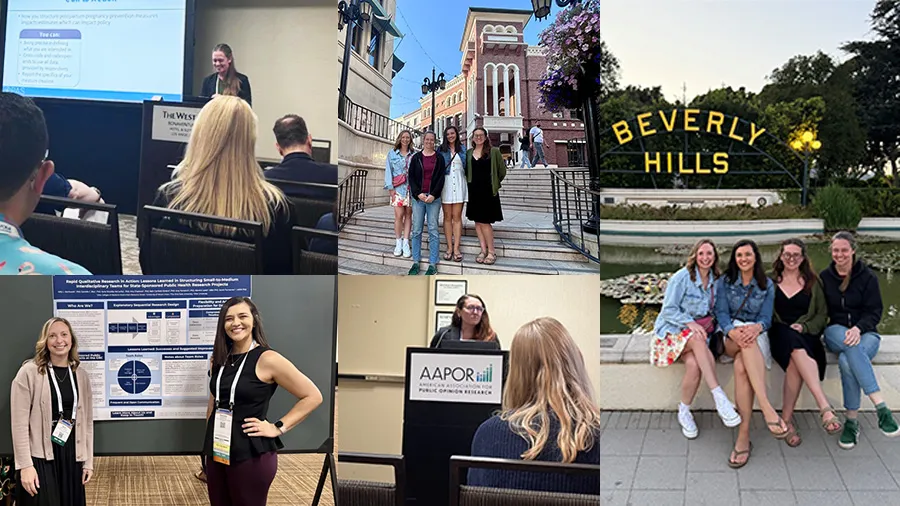
From May 13 to 15, GRC staff members Danielle Biss, Andrea Hatfield, Sarah Paramenter, and Nikki Schnitzler attended the 2026 American Association for Public Opinion Research Annual Conference in Los Angeles, California. The conference is widely recognized as a leading forum for researchers to exchange ideas and share new developments in survey methodology and public opinion research.
Danielle Biss and Sarah Paramenter co-presented a poster titled, “Rapid Qualitative Research in Action: Lessons Learned in Structuring Small-to-Medium Interdisciplinary Teams for State-Sponsored Public Health Research Projects.” Their presentation drew on GRC’s recent work to highlight practical strategies for organizing interdisciplinary teams that can quickly deliver meaningful qualitative insights. They also engaged with attendees on topics such as team structure, maintaining analytic rigor under tight timelines, and the thoughtful use of artificial intelligence in research.
Andrea Hatfield presented challenges related to estimating postpartum pregnancy prevention using the PRAMS Core 9 questionnaire. Using data from the 2023 Ohio Pregnancy Assessment Survey (OPAS), her presentation demonstrated how different approaches to measure construction can significantly influence reported outcomes and interpretations.
“In the absence of guidance from PRAMS, researchers use a range of methods to construct postpartum pregnancy prevention measures, and our work shows that these choices can significantly change birth control use estimates,” said Andrea Hatfield, MS, MEd. “This highlights the importance of thoughtful measure construction and clearly reporting the methods used.”
Nikki Schnitzler presented findings from an incentive experiment conducted as part of the 2025 Ohio Medicaid Assessment Survey. Her presentation, “What’s the Right Price? An Incentive Experiment to Determine the Best Approach across Multiple Populations of Interest,” explored how varying incentive strategies impact response rates. The work, developed in collaboration with survey partner RTI, sparked valuable discussion among peers working with similar populations and survey designs.
“After presenting at AAPOR, we connected with a researcher working on Iowa’s OPAS-equivalent who had been grappling with this same question set,” said Andrea. “We are now planning to collaborate on future code development to support this work.”
Through these presentations, GRC staff contributed to national conversations on research methods and shared insights that continue to strengthen public health data collection and analysis.